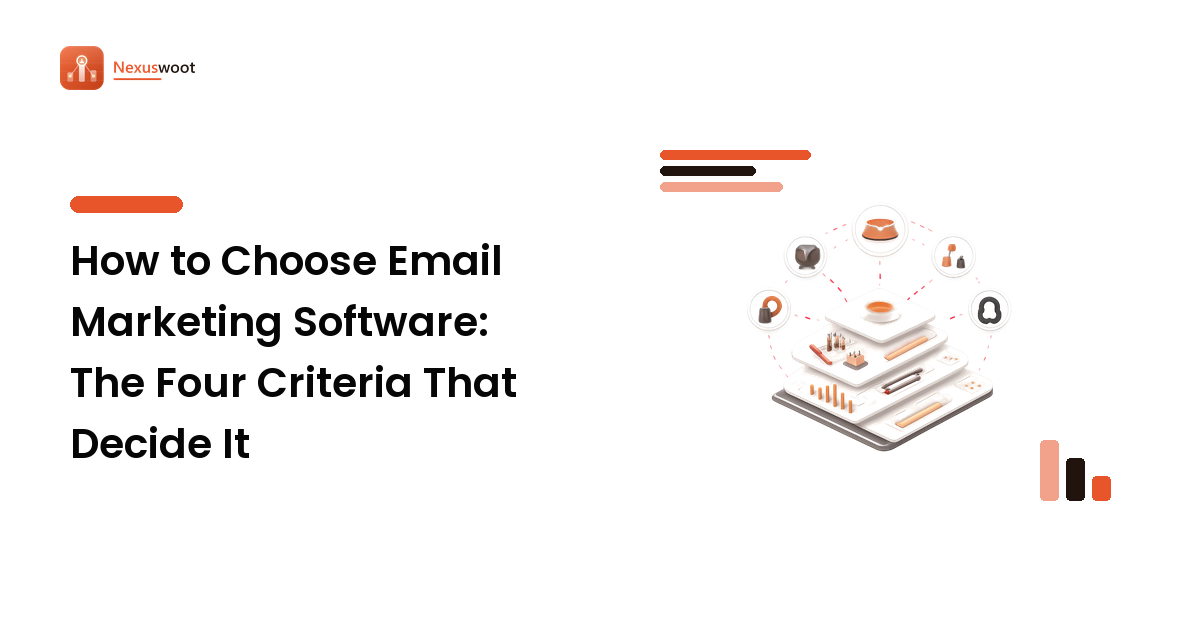
Email is the channel you own. No algorithm decides whether your newsletter reaches the people who asked for it — but your email platform quietly does. It shapes whether you land in the inbox or the spam folder, whether your welcome sequence runs itself or runs you, and whether your bill stays sane as the list grows. Choosing that platform by brand recognition is how marketers end up rebuilding their list somewhere else a year later. Evaluate on four criteria — deliverability, automation depth, ease of use, and value — in that order, against your real sending. Here is how to test each one before you commit a list to anybody.
This guide follows the criteria-first method from our business software evaluation framework, applied to the email category specifically.
First, know what job you're hiring email for
"Email marketing software" covers three different jobs, and platforms specialize:
- Broadcasts and newsletters — one-to-many sends to a list, on your schedule.
- Automated sequences — welcome series, onboarding, and courses that trigger when someone joins or acts.
- Behavioral automation — flows that branch on what a subscriber clicks, buys, or ignores, often tied to a store or app.
A creator sending a weekly essay, an e-commerce store recovering abandoned carts, and a B2B team nurturing demo signups need genuinely different tools. Write down which of the three jobs dominates for you, plus your list size and expected sending frequency. Every criterion below gets weighted by that answer.
Criterion 1: Deliverability — the one you can't see on the pricing page
Deliverability is the probability your email reaches the inbox rather than spam — and it is the criterion vendors talk about most while proving least. Every platform claims great deliverability; none of them publish numbers you can audit for your use case, because deliverability depends heavily on your list quality and sending behavior, not just their infrastructure.
So evaluate what you can actually verify:
- Authentication support. The platform must make SPF, DKIM, and DMARC setup straightforward on your own domain — these are the DNS records that tell mailbox providers your mail is legitimately yours. Mainstream mailbox providers now effectively require proper authentication from bulk senders; a platform that buries or half-supports this is disqualifying itself.
- Custom sending domain. Sending from your own authenticated domain, not only the platform's shared one, is what lets you build a reputation you keep.
- List hygiene tooling. Does the platform make it easy to confirm opt-ins, prune inactive subscribers, and automatically handle bounces and complaints? Spam-folder placement is mostly earned by sending to people who don't engage; good tools make the healthy behavior the default.
- Reputation signals in the trial. During evaluation, send a real campaign to a seed list of your own inboxes across the major mailbox providers and see where it lands. It's a small sample, but it's your sample.
One structural note: on any shared infrastructure, sender behavior is pooled — platforms that police their customers' list quality strictly tend to be the ones whose mail is trusted. A strict onboarding review is a feature, not friction.
Criterion 2: Automation depth — buy for the flows you'll build this year
Automation is where feature-grid deception is worst. "Has automation" can mean a simple timed drip (email 1, wait three days, email 2) or a full visual builder with branching, tags, goals, and event triggers. Both tick the checkbox; they are not the same product.
Map the flows you genuinely expect to run in the next twelve months. For most small teams that's three: a welcome sequence, a periodic newsletter, and one revenue flow (cart recovery, demo follow-up, or a launch sequence). Then test, in the trial:
- Trigger variety. Can a flow start from a form fill, a tag, a link click, a purchase, or an API event — whichever your revenue flow needs?
- Branching. Can the sequence take a different path for subscribers who clicked versus those who didn't? Timed-only drips run out of road quickly.
- Segmentation. Can you build the audience slices you'll actually send to — customers vs prospects, engaged vs dormant — without exporting to a spreadsheet?
- Exit and conflict rules. What happens when someone qualifies for two flows at once, or buys mid-sequence? Mature platforms answer this; immature ones double-send.
Beware of buying automation ceiling you won't reach. Deep behavioral automation is priced accordingly, and an unused flow builder is the most expensive kind of empty. If your CRM already handles sales-side sequences, decide deliberately where nurture lives — our CRM buying guide covers that boundary.
Criterion 3: Ease of use — friction compounds weekly
You will touch this tool every week for years. Small friction — a clumsy editor, a confusing list model, sends that need three approvals — compounds into campaigns that ship late or not at all.
Test with real work, not the vendor tour. In each trial platform, build the same real email you sent last month: your template, your images, your footer. Time it. Then check the structural things that surface later:
- The contact model. Some platforms organize people into separate lists, others into one pool with tags and segments. Tag-based models generally handle overlap better (one person, many interests) and prevent double-billing the same subscriber in two lists — a real pricing artifact of list-based models.
- Editor honesty. Does the drag-and-drop output render properly in the inboxes your audience uses? Send the test to your seed inboxes and look.
- Reporting you'll read. Opens are increasingly unreliable as a metric (privacy features inflate them); clicks and conversions are the numbers worth optimizing. Can you see them per-flow and per-campaign without a data export?
- Who can operate it. If only one person on the team can safely send, your bus factor is one.
Criterion 4: Value — decode per-contact pricing before your list grows into it
Email platforms overwhelmingly price per contact: the bill climbs in tiers as your list grows. This is the category's defining pricing trap, because the cost of success is written into the model. Before choosing, price every candidate at your current list size and at double — the ranking often changes at 2×.
Watch the mechanics that inflate the effective price:
- Who counts as a contact? Some platforms bill for unsubscribed or bounced contacts until you manually delete them, and list-based models may count duplicates twice. The same nominal tier can cost meaningfully different amounts depending on the counting rules.
- Feature-gated tiers. Automation branching, advanced segmentation, and integrations commonly sit one tier above the advertised price. Price the tier that contains your must-have flow, not the teaser.
- Send-volume limits. Per-contact plans sometimes cap monthly sends too; frequent senders can hit the second meter.
- Free-plan walls. Generous free tiers are real in this category, but check what crossing the wall costs and whether your authenticated domain and automations survive the upgrade intact.
Value is the criterion where "best" most obviously depends on you: a 2,000-contact newsletter and a 50,000-contact store shop in different markets that happen to share a name.
Run the decision
Weight the four criteria for your job (deliverability is near-universal top weight; automation depth varies most), shortlist three platforms that pass your dealbreakers, and run a one-week structured trial: authenticate a test domain, build one real flow, send one real campaign to seed inboxes, and price the paid tier at double your list. Score against your weights and the decision usually makes itself.
FAQ
What's the difference between drip sequences and marketing automation? A drip is time-based: fixed emails at fixed intervals after a trigger. Automation is behavior-based: flows that branch on what the subscriber does — clicks, purchases, inactivity. Drips are enough for welcome series and courses; revenue flows like cart recovery need true automation.
How can I actually test a platform's deliverability? You can't audit a vendor's global rates, but you can verify what predicts your outcome: easy SPF/DKIM/DMARC setup on your own domain, custom sending domains, strict list-hygiene tooling, and a trial send to your own seed inboxes across major mailbox providers to see where it lands.
Should my email marketing live in my CRM instead of a separate platform? If your email is mostly one-to-one sales follow-up, CRM-native sequences may be enough. If you send broadcasts and behavioral flows to a growing list, a dedicated platform typically wins on deliverability tooling and automation depth. Decide where nurture lives before you buy either.
Is switching email platforms later a big deal? Moderate — and manageable if you prepared. Contacts and templates export easily; automation flows must be rebuilt, and your sending reputation restarts on a new domain or IP, so plan a gradual warm-up. Keep your list clean and your domain authenticated and you stay portable.
Compare the platforms side by side
You now have the criteria, the tests, and the pricing traps. What's left is the scoring — and that's the part Nexuswoot does programmatically, with sourced pricing tables, per-criterion scores, and a stated "best for" on every pick. Compare the best email marketing platforms on Nexuswoot to turn these criteria into a shortlist you can trial this week. (Disclosure: Nexuswoot may earn a commission from some of the tools it compares; rankings follow the published criteria, not payouts.)